OrgX
Continuity infrastructure for AI agents: persistent organizational memory, trust scoring, decision provenance, and MCP tooling across Claude Code, Cursor, and ChatGPT.
OrgX is the clearest expression of how I think about agent infrastructure. Delegate aggressively, keep provenance visible, and make the review surface strong enough that human judgment can stay precise instead of becoming a bottleneck.
npx @smithery/cli install @useorgx/orgx-mcp --client claudeView on Smithery ↗The boring infrastructure choices that matter
The public narrative around MCP today is "connect a tool to a model." That's table stakes. The harder question is: how do you run an MCP server that production teams will actually trust with real organizational state?
OrgX MCP is built on Cloudflare Workers + Durable Objects because session isolation, SQLite persistence, and cross-deploy state survival matter more than easy scaling. Auth uses OAuth 2.1 with dynamic client registration — no API keys, no shared secrets — because every serious MCP client is going to need this in six months anyway.
- OAuth 2.1 + PKCE + DCR: credentials never touch environment variables.
- Durable Object SQLite: session and workspace state survive deploys.
- Ed25519-signed registry: domain verification, automated release pipeline.
- Context pointers, not embeds: entities reference URLs and other entities without payload bloat.
- Inngest over Temporal: workflow durability without a separate orchestration cluster.
- Supabase over custom backend: real-time subscriptions, auth, velocity — one system.
orgx-mcp internals
auth
  OAuth 2.1 + PKCE
  dynamic client registration via POST /register
  no API keys in env — creds in Durable Object SQLite

state
  Durable Objects for session isolation
  cross-deploy persistence across Worker restarts
  context[] JSON pointers on every entity

registry
  Ed25519-signed domain verification
  automated release pipeline to Smithery

transport
  HTTP streaming + SSE fallback
MCP Apps widget rendering for compatible hostsWhat the platform actually does
OrgX treats the organization, not the single prompt, as the primitive. Tasks turn into workflows. Agents become operating actors with tool access, trust boundaries, cost footprints, and quality history.
The value is not just that the system can delegate. The value is that delegation stays legible: you can see what was routed, which tools were used, what quality bar was applied, and where a human stepped in.
- Spawn and route specialist agents without losing context.
- Gate autonomy through trust tiers instead of hard-coded fear or blind freedom.
- Carry decisions, learnings, and costs forward through org memory and outcome attribution.
trust tiers
strict   -> read, analyze, propose; no mutation without approval
balanced -> low-risk mutation allowed; medium risk escalates
open     -> full autonomy inside tool and budget guardrails

spawn guards
  max_agents_per_task: enforced
  budget_per_run: enforced
human escalation: required for destructive actionsThree layers keep the platform honest
OrgX architecture
Events drive durable execution, governance decides what can happen next, and the intelligence layer records quality, cost, and memory.
The product surface is part of the system
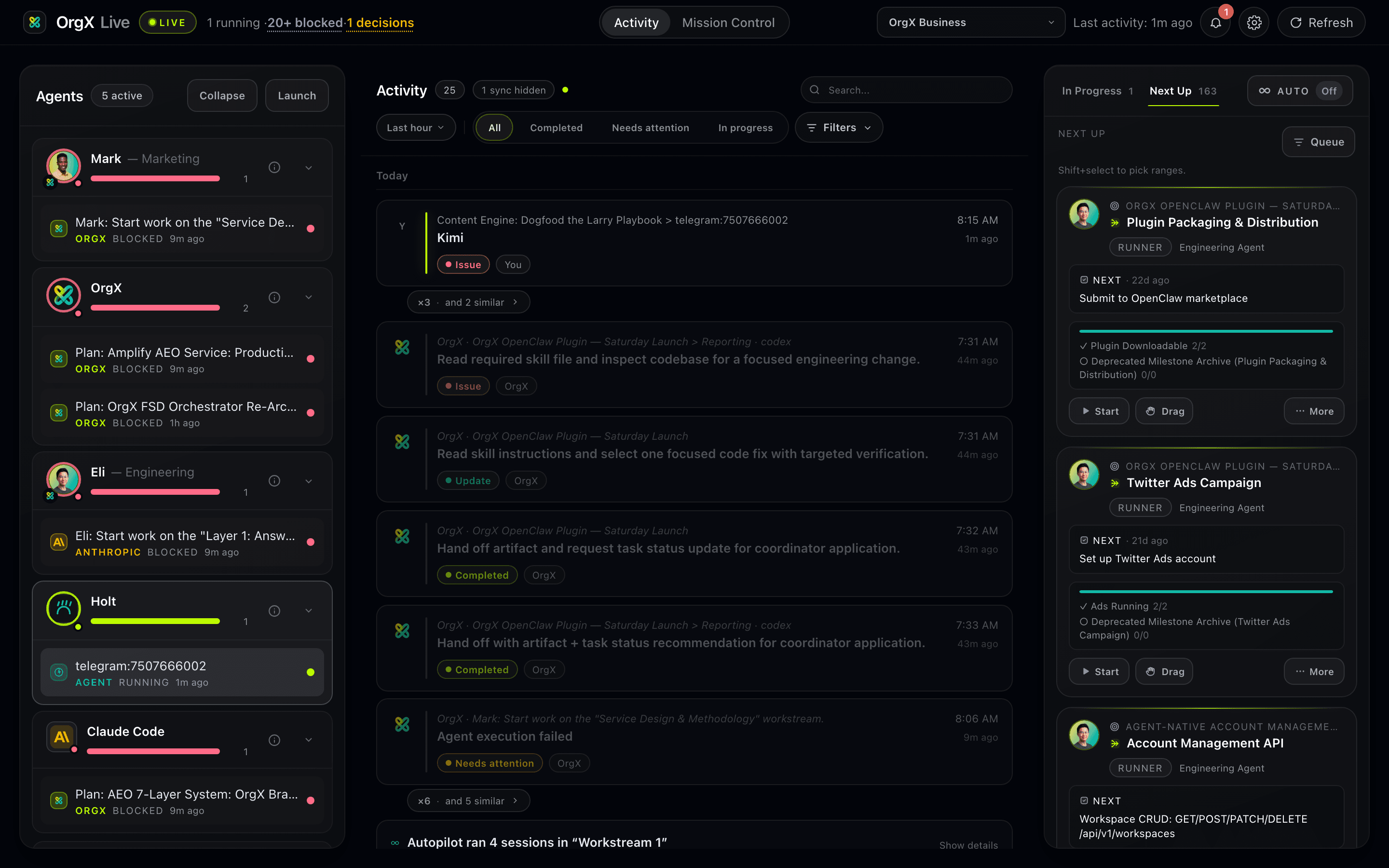
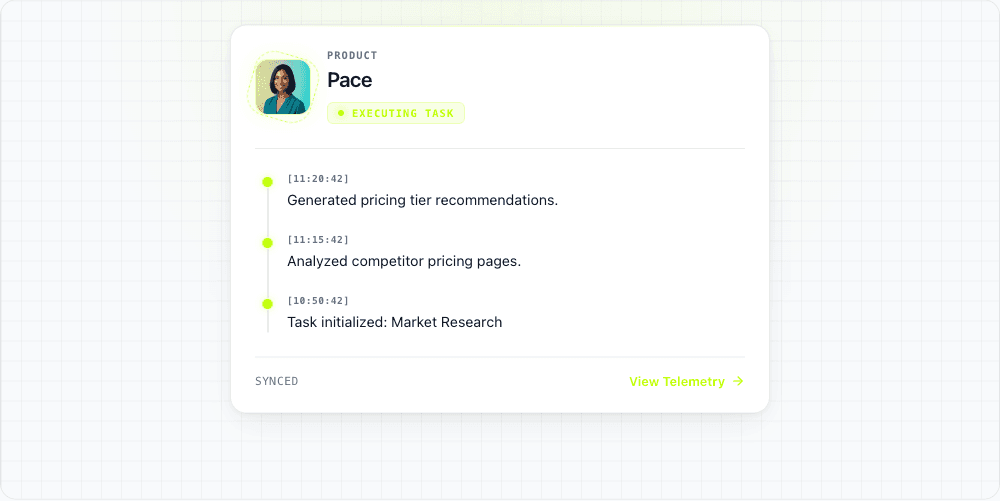
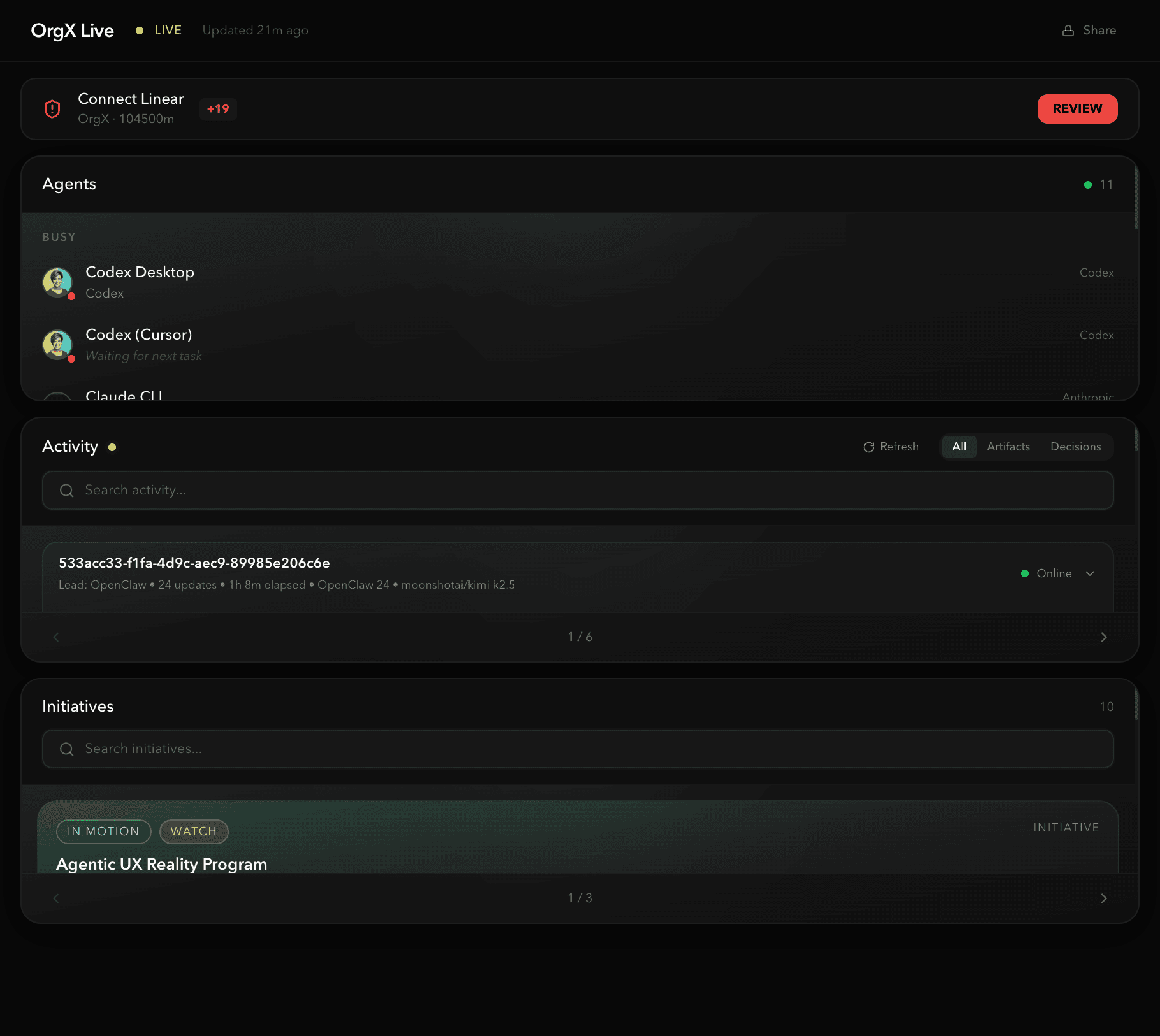
Six production MCP Apps widgets — UI that renders inside any MCP host
Every OrgX widget ships typed data contracts, demo / loading / empty states, and SSR-safe rendering so an MCP host can embed them in a chat surface or dashboard without custom code. These are real demos, served live at mcp.useorgx.com/widgets ↗.
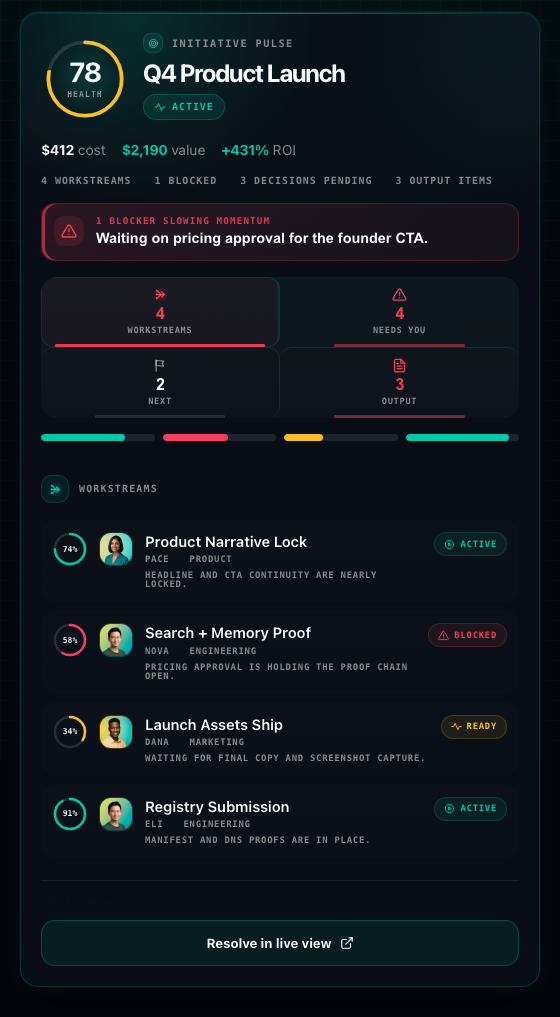
Health, ROI, and blockers in a single conversational card. 78 health score, +431% ROI, 1 blocker surfaced with resolution path.
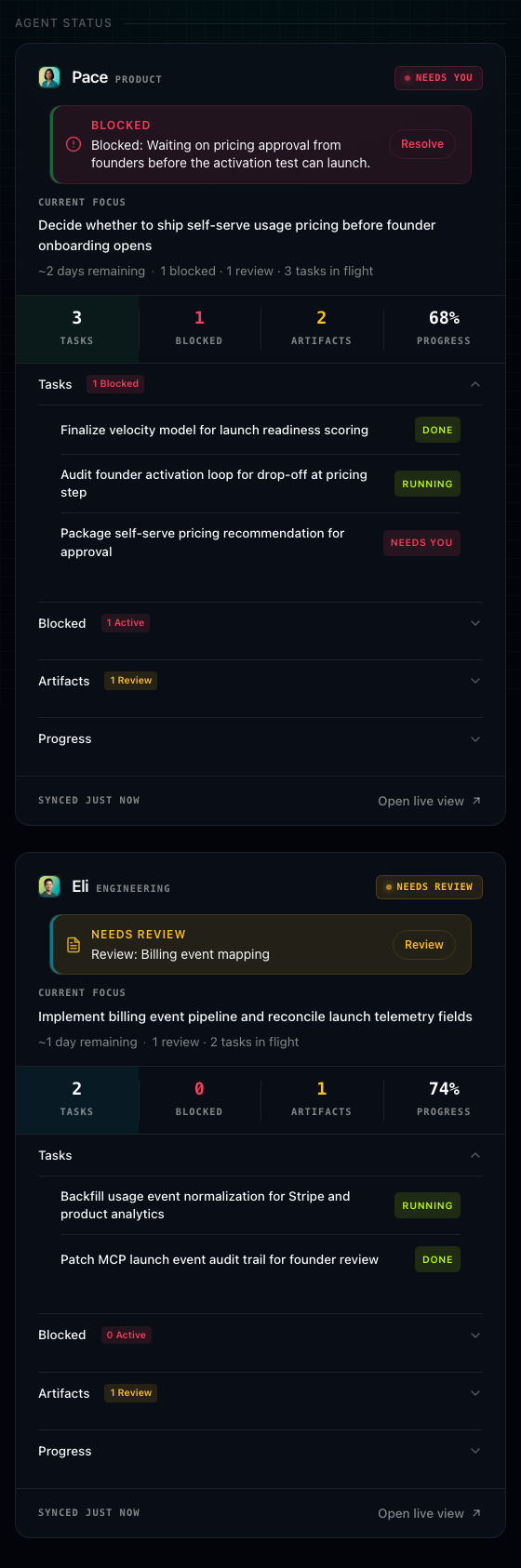
Live status of every specialist agent. Current focus, tasks in flight, blocked/review signals, and the “needs you” prompts that drive human review.
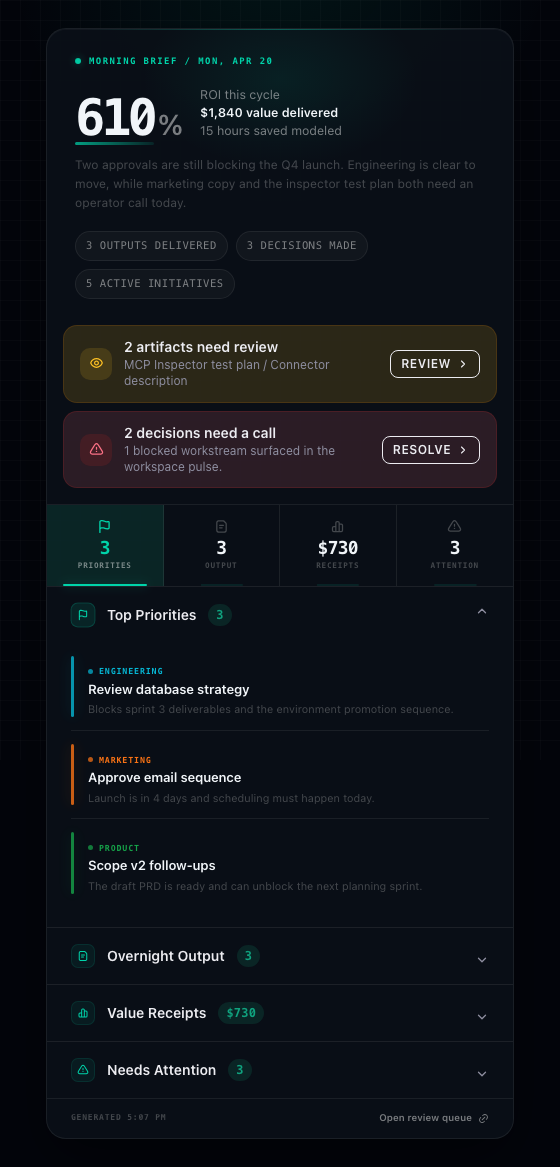
Daily executive summary. Top priorities by domain, decisions made, receipts, and what needs attention — generated and citable.

Interactive approval surface with approve / revise actions, cost estimates, and countdown-to-auto-approve. The UI that closes the human-in-the-loop.
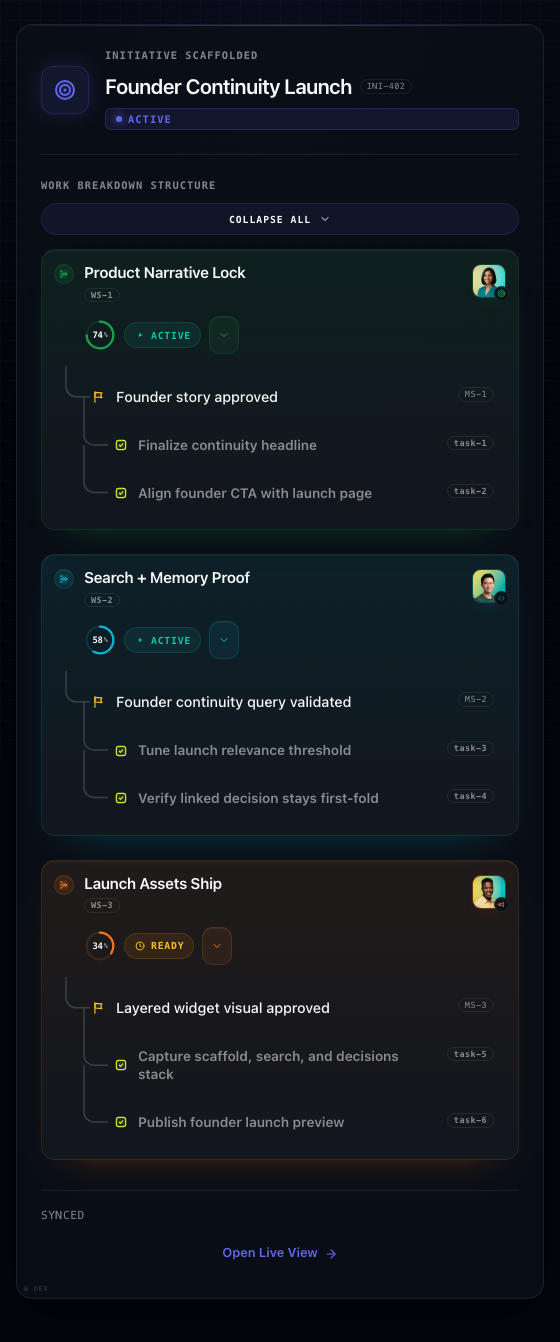
Work-breakdown structure rendered from a typed scaffold event. Workstreams, milestones, and tasks with live status badges and owners.
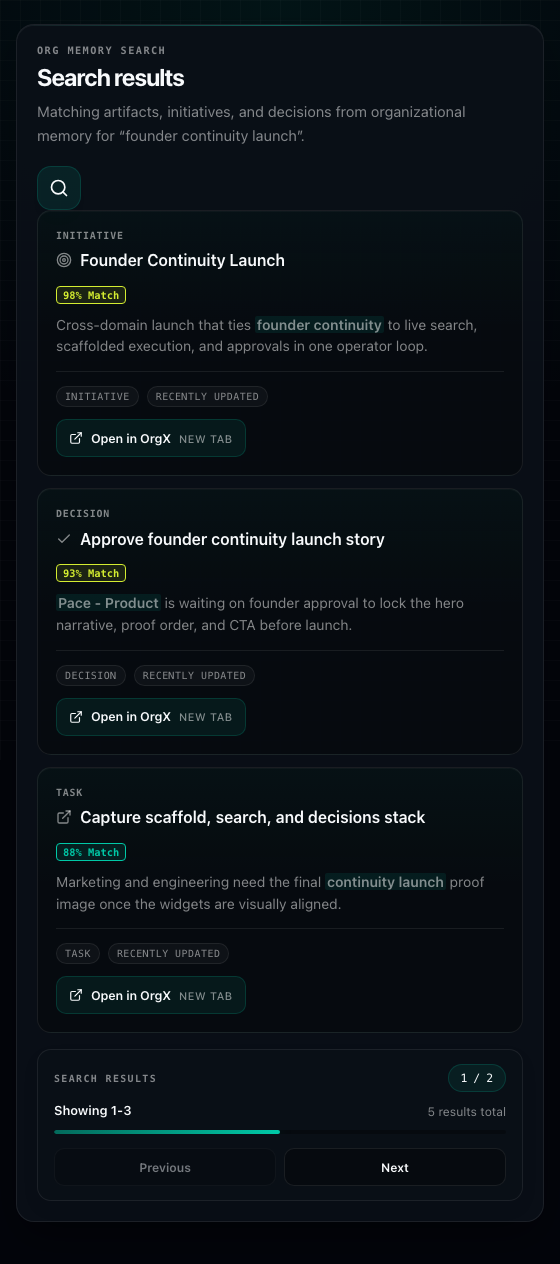
Unified retrieval across artifacts, decisions, and initiatives with relevance scores. The shape of memory, visible.
Single-shot benchmarks hide what agents can't fake
Most agent benchmarks are single-shot: one prompt, one model, one task. That structurally hides the thing that actually breaks in production — cascading context across sessions, tools, and time.
The OrgX benchmark evaluates cross-session continuity, memory handoff, and decision provenance across real initiatives. Results, judgments, token costs, and failure cases are published openly.
autonomous-initiative-benchmark
tasks               136+
domains             7 (product, eng, ops, design, ...)
execution modes     3 (agent, api, cli)
judges              independent LLM panels
artifacts           task, judgment, cost, token logs
failure cases       published with human review notes

methodology         useorgx.com/blog
next run            more inclusive — more models,
more domains, broader substrate12 repos, one coherent platform
orgx-mcp ↗ — 61 MCP tools · Cloudflare Workers + Durable Objects · OAuth 2.1 + DCR
orgx-gateway-sdk ↗ — Gateway Protocol v1 client SDK
openclaw-plugin ↗ — 30-tool MCP + browser mission control
orgx-claude-code-plugin ↗ — Claude Code runtime integration
cursor-plugin ↗ — MCP, rules, skills, hooks, commands
orgx-codex-plugin ↗ — Codex + initiative-aware skills
orgx-opencode-plugin ↗ — OpenCode peer driver
orgx-ui-kit ↗ — React components + tokens
orgx-data ↗ — typed contracts + React hooks
orgx-local-shell ↗ — Tauri 2 desktop app
skills ↗ — reusable agent skill library
autonomous-initiative-benchmark ↗ — public methodology + catalog
Install OrgX MCP in a compatible client
The MCP server exposes 61 tools for org memory, planning, decisions, scoring, and workspace management. It works in Claude Desktop, Claude Code, Cursor, and any compatible MCP client.
Dynamic client registration handles auth. Durable Objects handle state survival across deploys. You get working context in the first session.
install
# Smithery (recommended)
npx @smithery/cli install @useorgx/orgx-mcp --client claude

# Direct MCP config
{
  "mcpServers": {
    "orgx": {
      "url": "https://mcp.useorgx.com"
    }
  }
}
OrgX is the system I’d build again from scratch tomorrow.
If you're hiring for agent infrastructure, agent platforms, AI developer productivity, or MCP tooling — this is a preview of the work I'll ship on your team from day one.